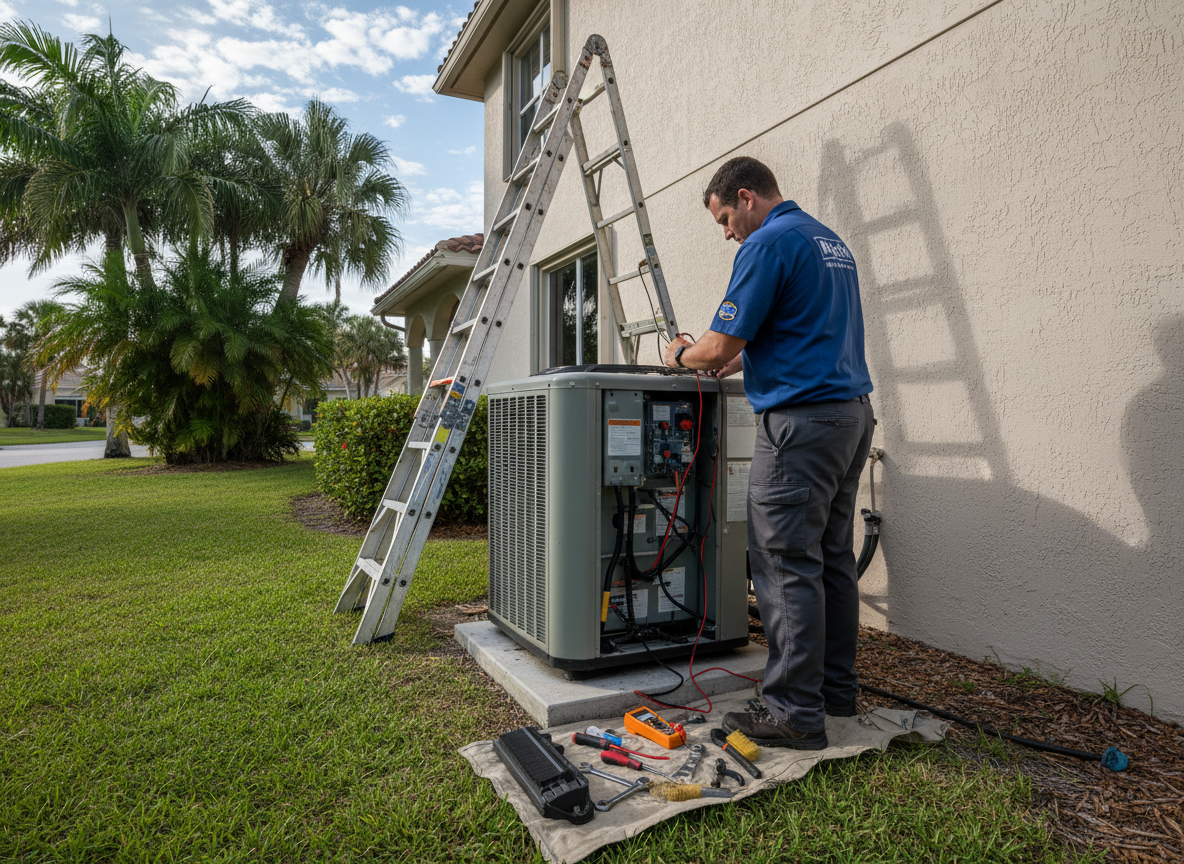
Tierra Verde homes sit directly on the bayway and face constant salt-laden air that pits aluminum fins and copper coils faster than inland properties. Technicians routinely find pitted evaporator coils and seized contactors on units installed in the 1990s and early 2000s, when many island residences were built. High dew points year-round keep condensate pans full, allowing algae to block drains and trigger freeze-ups that homeowners mistake for low refrigerant.
Repairs often require stainless-steel fasteners and coated coils to slow future corrosion, plus verification that the condensate line exits above the flood elevation required by Pinellas County. Older ductwork in crawl spaces frequently shows rusted joints that leak conditioned air into humid attics, raising indoor humidity and forcing the system to run longer cycles. Checking static pressure and cleaning the blower wheel during every visit prevents repeat callbacks that are common when only the capacitor is replaced.
Technicians carry factory-matched capacitors, contactors, and TXVs sized for the exact tonnage found in Tierra Verde’s elevated concrete-block homes. Before leaving, they confirm the disconnect rating matches the updated load calculation required after any major component swap. Skipping this step can violate the local electrical code and leave the homeowner responsible for damage during the next tropical storm.
Technician insight
In Tierra Verde, the thing that catches most people out with AC repair is how fast salt air eats through the contactor and capacitor on rooftop units mounted on pre-2005 homes along the Pinellas Bayway; the corrosion starts on the underside where homeowners never look until the unit simply won’t start.
Rooftop Unit Failure After Storm
A Tierra Verde residence lost cooling two days after a heavy rain event. Inspection showed the contactor contacts fused from salt pitting and the condensate drain clogged with algae. Replaced the contactor with a sealed unit, flushed the line, and restored operation without further water intrusion into the attic.
How it works
- 1
Initial Assessment
Arrive on site, confirm power at the disconnect, and document model numbers while noting visible salt buildup on the outdoor unit.
- 2
Diagnostic Testing
Measure pressures, temperatures, and amperage draw to isolate whether the issue is electrical, mechanical, or airflow related.
- 3
Component Replacement
Replace failed parts with corrosion-resistant equivalents and flush the condensate line to prevent immediate re-clogging.
- 4
System Verification
Run the unit through a full cycle, check static pressure, and confirm the thermostat is calling correctly before departure.
Pricing
Upfront quotes issued after inspection; cost driven by parts availability and access constraints typical of island properties.