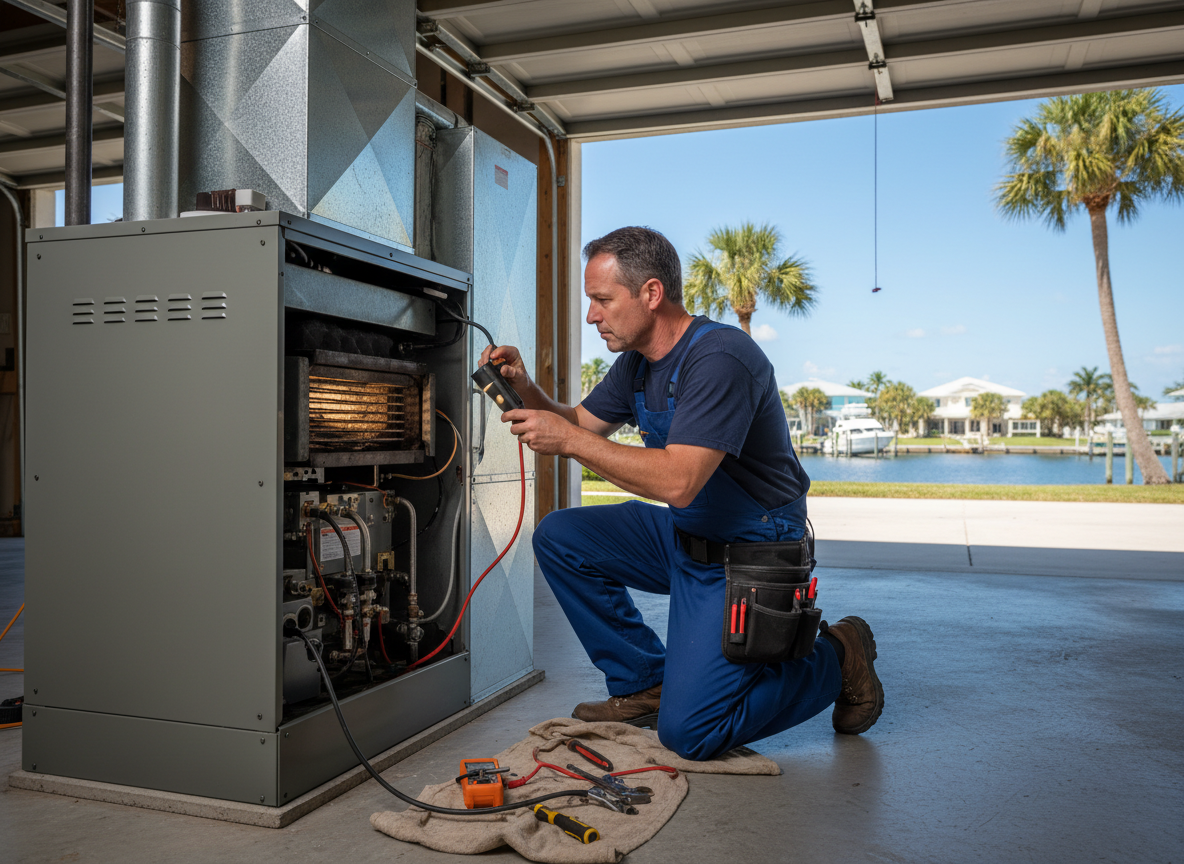
Tierra Verde homes often feature older HVAC setups installed when the island developed, with many units now facing corrosion from constant bay exposure. Salt air accelerates rust on heat exchangers and burners that sit idle for most of the year until a rare cold front arrives. Technicians at Axis Mend check for pitting and scale buildup that standard mainland inspections miss because the local humidity keeps components damp even when the furnace is off.
Pinellas County codes require proper venting and combustion air in waterfront properties where wind-driven moisture can enter flues. During repairs we verify that inducer motors and pressure switches still meet these standards after years of exposure. Ignoring this step often leads to repeated shutdowns once temperatures dip below 50 degrees, a pattern we see repeatedly in canal-front neighborhoods.
Because furnaces here run so little, bearings dry out and limit switches fail from lack of exercise rather than heavy cycling. We test the full sequence including the rollout switch and flame sensor under load instead of relying on visual checks alone. This catches intermittent faults that appear only when the system finally starts after months of inactivity.
Technician insight
In Tierra Verde the thing that catches most people out with furnace repair is how quickly salt air from the bay corrodes the heat exchanger on systems that only run a few nights each winter; homes along the Pinellas Bayway see this faster than inland St. Petersburg properties because the constant moisture never fully dries out the metal.
Canal-front home shutdown
A Tierra Verde residence near the bayway called after the furnace shut down on the first cold night. We found heavy corrosion on the flame sensor and a weakened inducer motor from salt exposure. After replacing the sensor and cleaning the assembly the unit fired reliably and passed combustion testing.
How it works
- 1
Initial Safety Check
Shut down power and gas, then inspect for carbon monoxide risks and visible corrosion before any work begins.
- 2
Diagnostic Testing
Measure voltage, gas pressure, and temperature rise while running the furnace through a full cycle to isolate the failure point.
- 3
Component Repair Or Replacement
Clean or replace the flame sensor, igniter, or heat exchanger section as needed while protecting surrounding cabinetry from salt residue.
- 4
System Verification
Confirm proper operation, recheck venting, and advise on any upcoming maintenance that the local climate makes critical.
Pricing
Upfront quotes provided after inspection with no hidden trip fees.