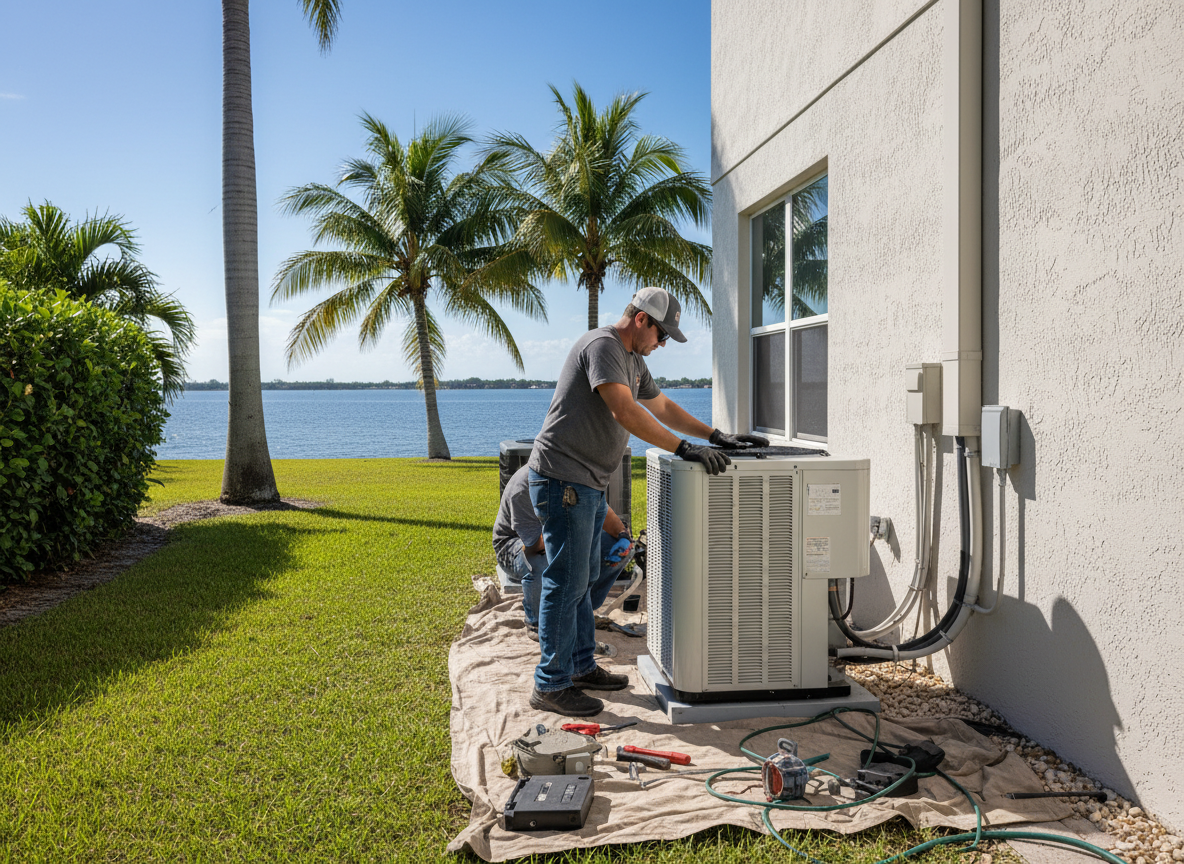
Tierra Verde homes sit on reclaimed land surrounded by Tampa Bay, so salt-laden air reaches condensing coils year-round and accelerates corrosion on fins and cabinets. Replacement jobs here often involve units installed in the 1990s or early 2000s that were sized for older, less insulated construction. New equipment must be matched to current Manual J loads that account for larger windows and open floor plans added during renovations. Technicians also verify that condensate lines clear the high water table common near the Pinellas Bayway before final placement.
High summer humidity in the Tierra Verde area means the evaporator coil must be selected for latent capacity, not just sensible BTUs. Oversized units short-cycle and leave moisture on surfaces, promoting mold inside the ductwork that runs through many crawl spaces. During replacement, existing duct transitions are inspected because older flex duct often collapses after years of exposure to the constant 80-plus percent relative humidity. Proper refrigerant line flushing and nitrogen purging prevent oil contamination that leads to compressor failure within the first season.
Pinellas County permitting requires documentation of SEER2 ratings and proper disposal of recovered refrigerant. Replacement also includes updating the disconnect and whip to meet current NEC standards, especially on elevated homes where wiring runs through exposed soffits. Homeowners frequently discover that their old pad has settled unevenly because of shifting fill material; a new level composite pad is set before the unit is placed to avoid vibration and future refrigerant leaks.
Technician insight
In Tierra Verde the thing that catches most people out with air conditioner replacement is how fast salt air eats through the fins on the bay side of the house. Units on the west-facing lots near the Pinellas Bayway often show coil failure two or three years earlier than the same model on the mainland, so we always check the existing unit's orientation and elevation before quoting the new equipment.
Corroded Coil Failure on Bayway Property
Homeowner reported weak airflow and high indoor humidity on a waterfront lot. Inspection found heavy salt corrosion on the outdoor coil and a collapsed return duct in the crawl space. The old 3-ton unit was removed, lines were replaced with coated copper, and a new 16 SEER2 system with enhanced latent capacity was installed on a raised composite pad. Humidity dropped and the system now runs longer cycles without short-cycling.
How it works
- 1
Load Calculation And Equipment Selection
A Manual J calculation is performed on site, factoring in Tierra Verde's waterfront exposure and recent home modifications before any equipment is ordered.
- 2
Old Unit Removal And Site Prep
The existing system is recovered, lines are flushed, and the pad is leveled or replaced to account for the soft fill common on island lots.
- 3
New Installation And Duct Integration
The new air handler or packaged unit is set, refrigerant lines are pressure tested, and duct transitions are sealed against the persistent humidity.
- 4
Startup, Testing, And Permit Closeout
System operation is verified across multiple stages, electrical components are checked, and paperwork is submitted to Pinellas County for final inspection.
Pricing
Pricing varies with tonnage, SEER2 rating, and whether duct modifications or electrical upgrades are needed on older Tierra Verde properties.