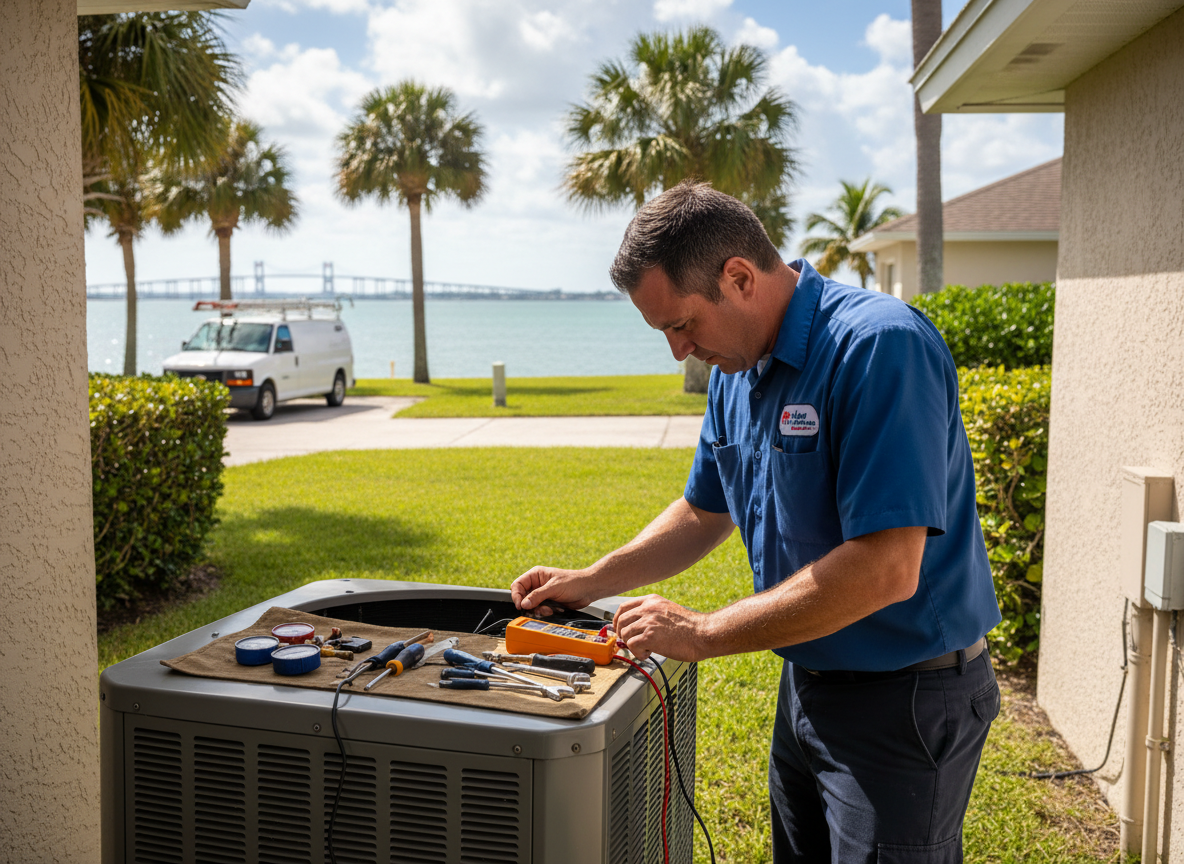
Tierra Verde homes sit on a barrier island in Pinellas County where salt air from the bay accelerates corrosion on outdoor condenser coils and electrical connections. Pre-summer tune-ups focus on rinsing coils with a mild solution that removes salt buildup without damaging fins, then checking capacitor ratings and contactor wear that spikes when humidity climbs above 80 percent in May. Technicians also inspect the condensate drain line for algae growth common in the area's warm, moist evenings, because a clogged line can back up and damage ceilings in single-story concrete-block houses built in the 1970s and 1980s.
Many Tierra Verde properties use older packaged units mounted on rooftops or slabs near the water, where wind-driven rain and salt spray reach the unit faster than inland St. Petersburg neighborhoods. During a tune-up the evaporator coil is examined for restricted airflow caused by pet dander and fine sand tracked in from nearby beaches, while the blower motor amperage is measured to catch early bearing wear before it fails during peak July loads. Refrigerant levels are verified against the nameplate because even small leaks become noticeable once daytime temperatures push past 90 degrees and the system runs longer cycles.
Local code in unincorporated Pinellas County requires proper disconnect placement and secure mounting for any unit within 10 feet of a pool or seawall, so the tune-up includes a quick check that these clearances remain compliant. Technicians also confirm that the thermostat is calibrated for the high latent load typical of waterfront homes, preventing short cycling that wastes energy and leaves indoor humidity elevated. These steps are performed with the system running so real operating pressures and temperatures are recorded before summer storms arrive.
Technician insight
In Tierra Verde the thing that catches most people out with pre-summer AC tune-up is how fast salt from the bay corrodes the contactor and capacitor terminals on rooftop units. Homeowners often skip the rinse because the unit still blows cold air, then wonder why it fails right when the first June humidity spike hits. Checking those connections while the system is running shows the real load before summer storms arrive.
Rooftop Unit on Pinellas Bayway
A homeowner noticed the AC running longer than usual in late April. On arrival the tech found heavy salt crust on the condenser fins and pitted contactor points from bay exposure. The coils were rinsed, the contactor was replaced, and the drain line was cleared. The system now cycles normally with restored efficiency ahead of summer.
How it works
- 1
Initial System Assessment
Technician arrives at the Tierra Verde address, verifies power and thermostat settings, then records baseline pressures and temperatures while the unit runs.
- 2
Coil and Drain Cleaning
Outdoor coils are rinsed to remove salt residue; indoor evaporator coil and condensate line are cleared of algae common in the humid bay environment.
- 3
Electrical and Mechanical Check
Capacitors, contactors, and blower motor amperage are tested; wiring is inspected for corrosion accelerated by coastal air.
- 4
Performance Verification
System is run through a full cycle, final readings are compared to baseline, and any needed adjustments are discussed with the homeowner.
Pricing
Upfront quote provided after initial assessment; cost varies with unit age, size, and any salt-related repairs needed.