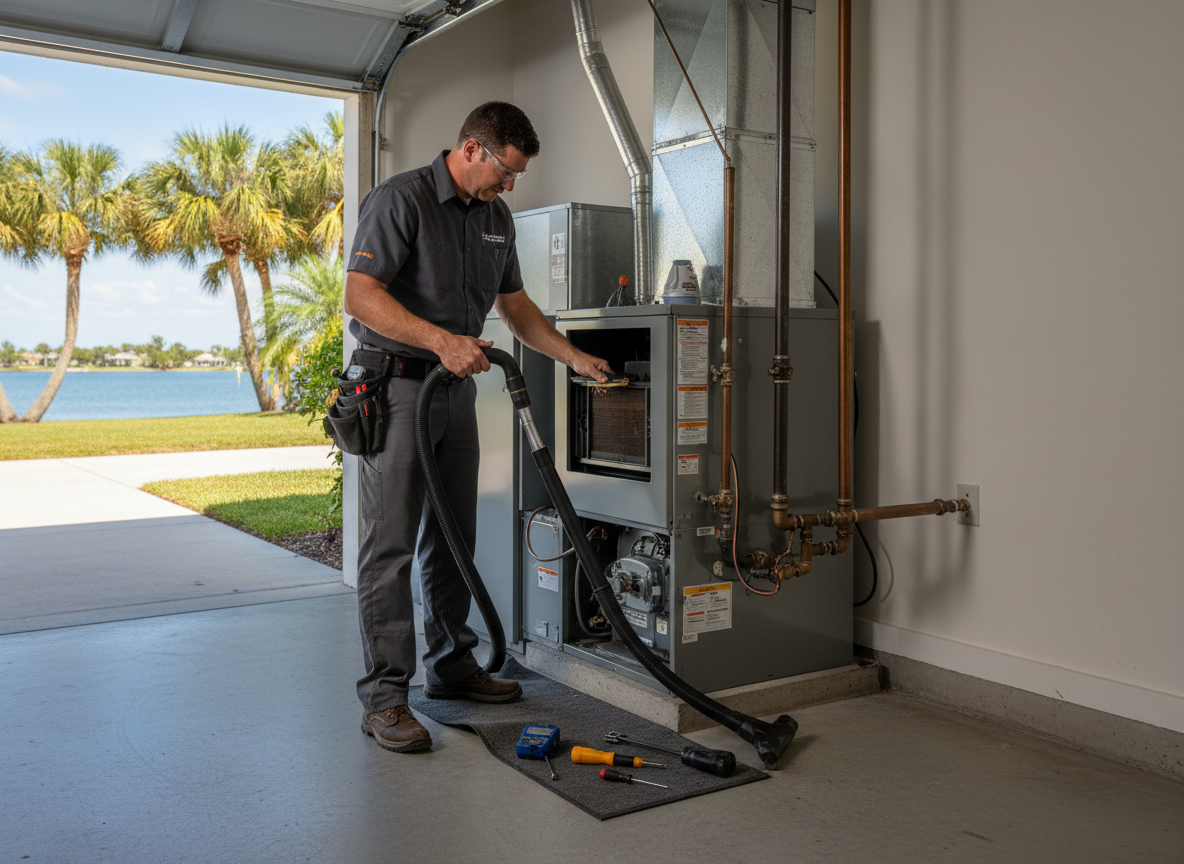
Tierra Verde homes sit on a barrier island in Pinellas County where salt-laden air accelerates corrosion on furnace heat exchangers and blower motors even during mild winters. A proper tune-up starts with checking for rust on the flue pipe and verifying the inducer motor can overcome the added resistance that builds after summer humidity. Technicians also inspect the condensate drain because standing water from prior dehumidification cycles often leaves behind mineral deposits that restrict airflow when the system finally runs in January or February.
Most Tierra Verde properties are slab-on-grade builds from the 1970s through 1990s with furnaces tucked in garages or utility closets that receive little ventilation. During a tune-up we measure static pressure across the filter and coil because salt crystals mix with dust to create a fine grit that reduces efficiency faster than in inland Tampa homes. We also test the limit switches, since rare overnight drops to the low 40s can cause short cycling if the thermostat anticipator is set for frequent summer use rather than infrequent winter loads.
Homeowners often overlook the need to verify gas pressure after the utility company performs seasonal line maintenance near the bridges connecting Tierra Verde to St. Petersburg. Low pressure shows up as weak burner flames and incomplete combustion that leaves soot on the heat exchanger. We finish every tune-up by confirming the furnace reaches steady-state temperature without exceeding the manufacturer’s rise range, a critical step when the unit may sit idle for ten months at a time.
Technician insight
In Tierra Verde, the thing that catches most people out with winter furnace tune-up is salt air corrosion on the inducer motor and flue joints. Homes built on the island in the 80s and 90s see this far more than mainland St. Petersburg properties because the constant breeze off the bay carries chlorides straight into open garage installations.
Cold Front Hits Tierra Verde Residence
A homeowner on Pinellas Bayway called after the furnace failed to start during a rare 38-degree night. We found heavy corrosion on the inducer wheel caused by years of salt exposure and a clogged condensate trap from summer humidity. After replacing the inducer assembly and clearing the drain, the unit maintained proper temperature rise through the cold snap without further issues.
How it works
- 1
Initial System Inspection
We examine the furnace cabinet, flue, and surrounding area for salt corrosion and check the age and condition of the heat exchanger.
- 2
Component Cleaning and Lubrication
Blower wheel, motor, and burners are cleaned of accumulated grit while bearings receive manufacturer-specified lubrication.
- 3
Safety and Performance Testing
We verify limit switches, pressure switches, and gas pressure, then run the system through a full cycle to confirm proper temperature rise.
- 4
Final Adjustments and Documentation
Filter is replaced if needed, thermostat settings are optimized for infrequent winter use, and findings are recorded for the homeowner.
Pricing
Upfront quotes provided after on-site inspection of your specific system and installation conditions.